The Two-Century Path That Made Quantum Computing Inevitable
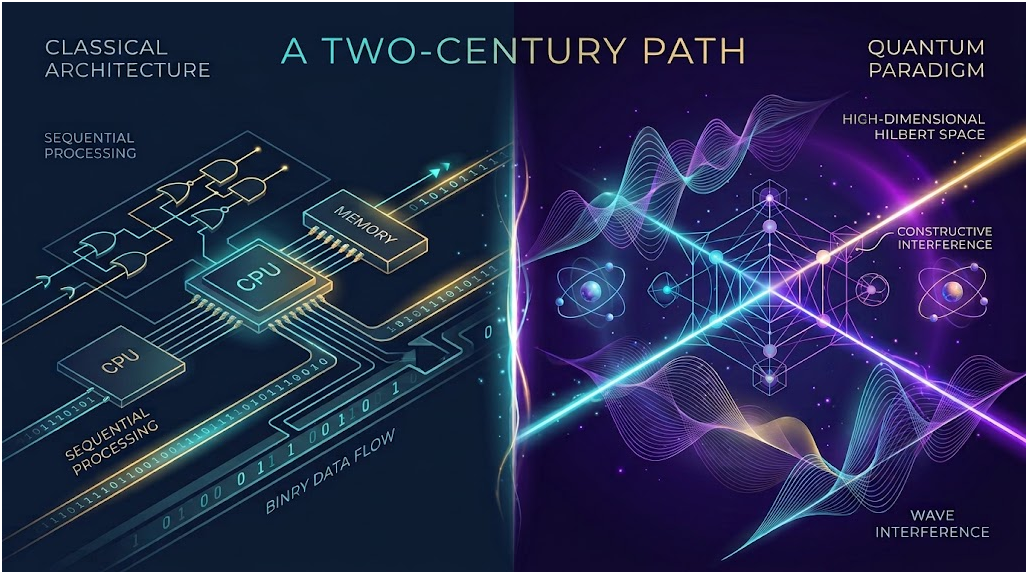
For two centuries, classical computing has evolved by making the substrate smaller and faster, while operating under the same fundamental sequential evaluation constraint. The industry is currently undergoing a pivotal architectural shift where quantum systems offer a new computational primitive, enabling the solution of multi-variable problems through high-dimensional Hilbert space evolution and interference, rather than sequential search.
As of 2026, the field has moved beyond laboratory proofs-of-concept toward utility-scale operations. This transition requires a shift in focus from raw physical qubit counts to system-level engineering, prioritizing error correction overhead, decoder latency, and high-performance hybrid integration. The most promising near-term applications, such as molecular simulation and algorithmic optimization, rely on the clean mapping of problems onto quantum state dynamics.
Ultimately, the path to sustained economic value lies in disciplined systems engineering. Organizations are increasingly concentrating capital on architectures that tightly integrate quantum co-processors with classical HPC environments, moving away from undifferentiated claims of quantum advantage toward measurable, repeatable performance on industrially relevant workloads.
Source: quantumcomputingreport.com
Publication date: 28.09.2026
Author: Areeha Tunio
- Log in to post comments