
IBM Quantum Integrates Bivariate Bicycle Formulations with Algebraic Outer Concatenation
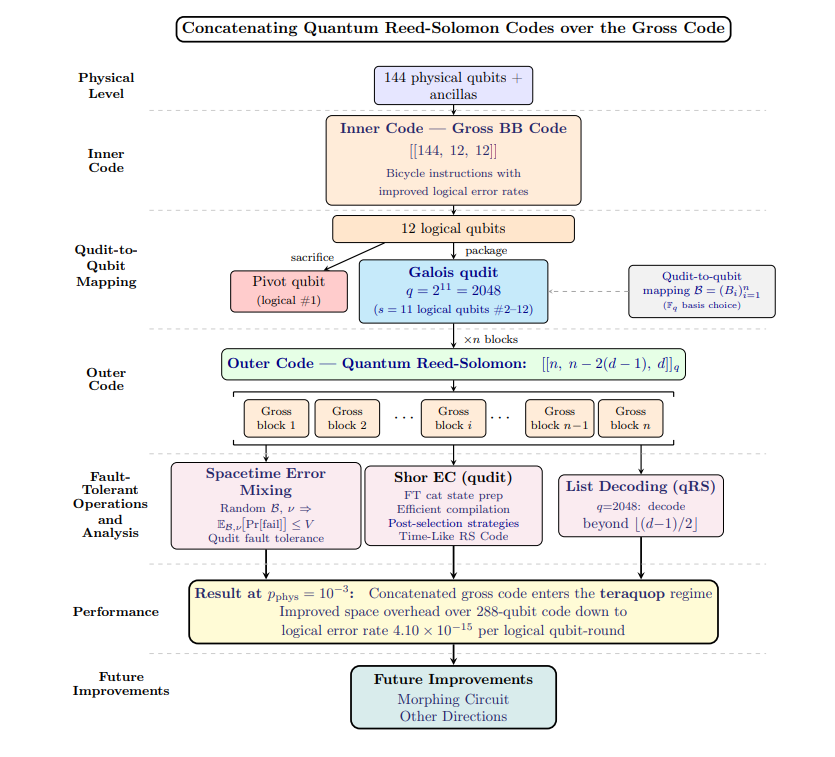
IBM Quantum has announced a significant expansion of its fault-tolerant roadmap by integrating high-rate quantum low-density parity-check (qLDPC) codes with algebraic outer block constraints. This development, detailed in an architectural briefing by Jay Gambetta, aims to bridge the gap toward the teraquop regime—where logical error rates are reduced to below one-quadrillionth per qubit-round—using a unified structural synthesis of 144-qubit bivariate bicycle codes.
The engineering breakthrough involves a new qudit-to-qubit mapping topology that isolates logical data from spatial correlations, which typically cause system-wide failures. By treating blocks of qubits as unified algebraic elements within a large-alphabet Galois field, IBM, in collaboration with MIT, has implemented a non-binary Quantum Reed-Solomon coding scheme. This allows the system to correct errors more efficiently while maintaining a reduced physical space overhead compared to previous unconcatenated frameworks.
Furthermore, the initiative addresses the bottleneck of magic state production by enabling in-situ generation of high-fidelity magic states within the Bicycle Architecture. Research conducted with the Ding Group at Yale University confirms that these gross code modules can sustain magic state factories natively, removing the need for external hardware and complex interconnects. This modular approach allows industrial operators to scale system performance linearly and adjust logical error rates dynamically.
Source: quantumcomputingreport.com
Publication date: 06.06.2026
Author: Mohamed Abdel-Kareem
- Log in to post comments