Sandia and Quantinuum Introduce Logical Gate Set Tomography to Map Fault-Tolerant Qubit Noise
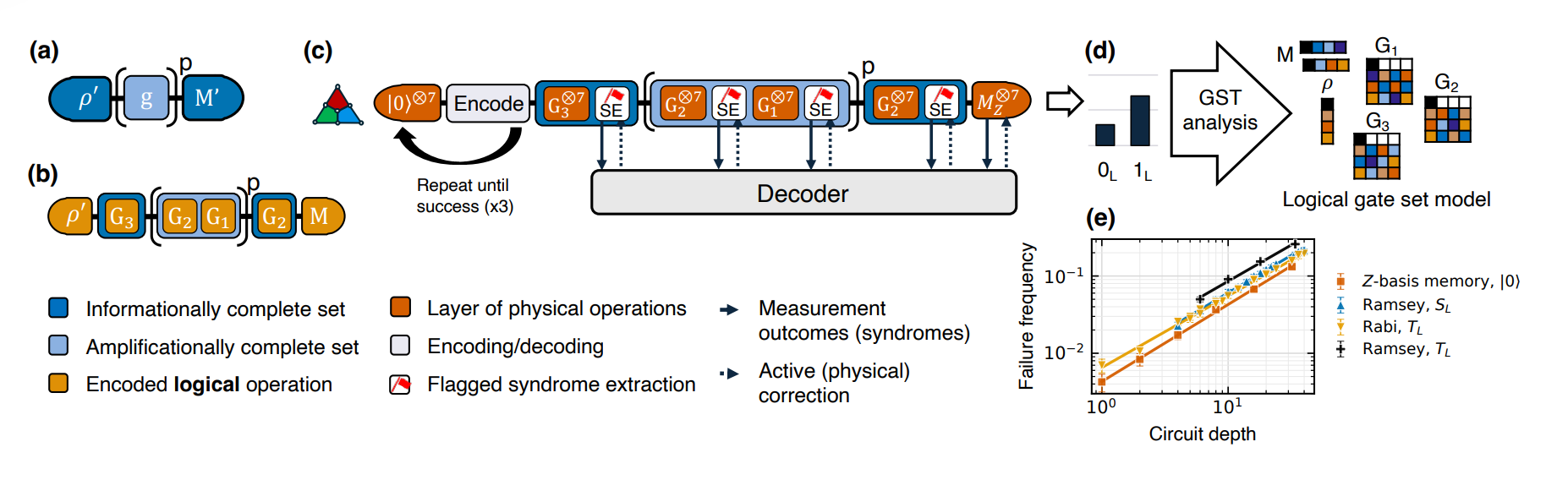
Researchers from Sandia National Laboratories and Quantinuum have introduced a new protocol called "Logical Gate Set Tomography" (Logical GST) to characterize noise in fault-tolerant quantum operations. Detailed in a study published on arXiv, the work marks the final experimental campaign on the 20-qubit trapped-ion Quantinuum System Model H1-1, representing the first self-consistent tomographic reconstruction of a universal single-qubit logical gate set.
Unlike standard logical benchmarking that often relies on software-based Pauli-frame tracking—which can mask coherent phase errors—the team utilized active quantum error correction through real-time classical feedforward. This involved applying physical correction pulses directly to the ions within the gate zones for a logical qubit encoded in the Steane code. The characterized gate set included logical state initialization, measurement, transversal Clifford gates, and a non-transversal T gate implemented via magic-state injection.
The experimental results confirmed that error correction successfully converted complex physical noise into simple, uncorrelated Pauli-stochastic channels. Furthermore, high-shot emulation revealed small but significant logical non-Markovianity and clear evidence of coherent logical over-rotations. The researchers demonstrated that physical dephasing during ion transport and sympathetic cooling is the primary driver of this coherent logical drift. This framework provides a platform-agnostic method to verify whether fault-tolerant quantum processors align with the theoretical noise models required by modern error-correction decoders.
Source: quantumcomputingreport.com
Publication date: 31.10.2026
- Log in to post comments